
DPHC
Department of Primary Healthcare in Bangladesh – Reform Proposal

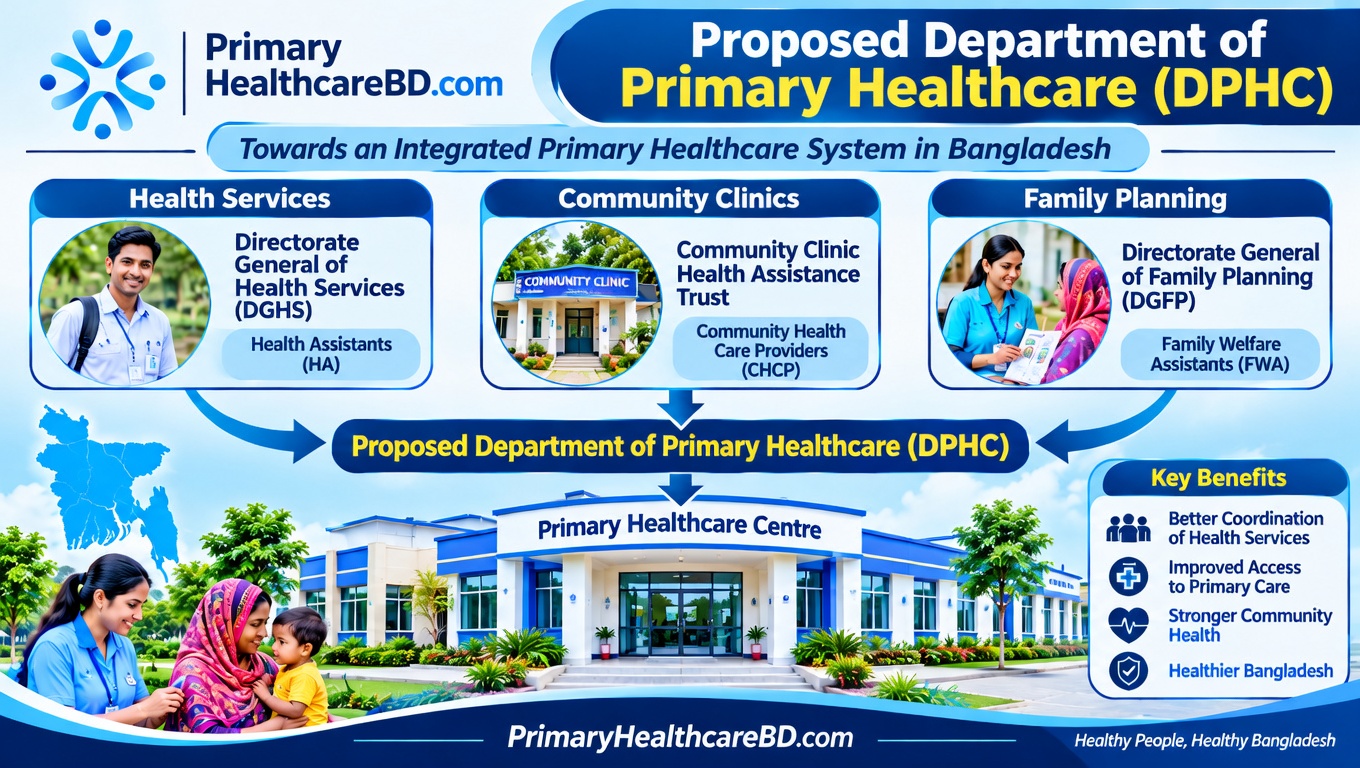
The Department of Primary Healthcare in Bangladesh (DPHC) is a proposed major healthcare reform initiative aimed at transforming the country’s primary healthcare system. Bangladesh is preparing for a major transformation through administrative reform, integrating grassroots health services, strengthening community-based healthcare and improving access to essential medical services across the country.
Bangladesh is preparing for a major transformation of its primary healthcare system. To achieve this goal, the government plans an administrative reform that will integrate grassroots health services, strengthen community-based healthcare and improve access to essential medical services across the country.
The proposed Department of Primary Healthcare (DPHC) will bring greater coordination among grassroots health services, strengthen community-based healthcare and improve access to essential medical services across the country. Additionally, the initiative focuses on integrating frontline healthcare workers, expanding recruitment and strengthening healthcare infrastructure at the union, ward and upazila levels.
Department of Primary Healthcare in Bangladesh: Executive Summary & Key Takeaways
- Administrative Reform: The government plans to establish the Department of Primary Healthcare in Bangladesh (DPHC) through the proposed reorganization of the Directorate General of Family Planning (DGFP).
- Unified Frontline Workforce: The proposed framework aims to integrate Health Assistants (HAs), Community Health Care Providers (CHCPs), Family Welfare Assistants (FWAs) and under a coordinated primary healthcare system.
- New Workforce Recruitment: Furthermore, the government has announced plans to recruit approximately 100,000 additional community health workers over the next three years.
- Integrated Healthcare Services: The proposed system aims to strengthen maternal health, child health, family planning, reproductive health, nutrition and preventive healthcare.
- Infrastructure Development: The Department of Primary Healthcare in Bangladesh aims to strengthen healthcare infrastructure by upgrading Upazila Health Complexes and establishing additional primary healthcare facilities at union and urban ward levels.
- Organisational Reform: A seven-member committee has been assigned to examine the proposed organogram, workforce structure, job responsibilities and career development arrangements.
1. Department of Primary Healthcare in Bangladesh: Latest Government Initiatives
Bangladesh’s healthcare administration is moving towards a significant structural transformation, with the government focusing on strengthening primary healthcare and improving community-level service delivery.
In addition, the Ministry of Health and Family Welfare (MOHFW) has initiated plans to bring different categories of frontline healthcare workers under a more coordinated administrative structure.
On November 26, 2026, Health Minister Sardar Md. Sakhawat Hossain Bakul and State Minister for Health Dr. M A Muhit highlighted the government’s healthcare priorities, including workforce recruitment, infrastructure development and improvements in grassroots healthcare services.
In particular, the broader policy direction focuses on preventive healthcare, early disease detection and accessible primary medical services.
As a result, the government aims to reduce pressure on major hospitals while ensuring that people in rural and underserved communities receive essential healthcare services closer to their homes.
2. Department of Primary Healthcare in Bangladesh: Proposed Structure and Reform
The proposed Department of Primary Healthcare in Bangladesh aims to create a unified administrative structure by improving coordination between existing healthcare institutions.
The proposal aims to establish a more integrated administrative framework for primary healthcare services by improving coordination between the Directorate General of Health Services (DGHS), the Directorate General of Family Planning (DGFP) and the Community Clinic Health Assistance Trust.
Historically, health services and family planning activities have operated through separate administrative structures. However, their responsibilities frequently overlap at the community level, and differences in management and operational arrangements have sometimes created duplication and coordination challenges.
Therefore, the proposed DPHC framework seeks to address these issues by bringing relevant services under a more coordinated system.
However, the final organisational structure, administrative authority and implementation arrangements will depend on official government decisions and notifications.
3. Department of Primary Healthcare: Workforce Integration in Bangladesh
The proposed primary healthcare reform will place frontline healthcare personnel at the centre of its integration strategy.
At the same time, the government intends to coordinate existing field-level healthcare workers from different institutions under a unified service delivery framework.
Proposed Frontline Healthcare Integration Model
| Existing Institution | Existing Workforce | Proposed Healthcare Responsibilities |
|---|---|---|
| Directorate General of Health Services (DGHS) | Health Assistants (HAs) | Immunisation, disease prevention and community health activities |
| Community Clinic Health Assistance Trust | Community Health Care Providers (CHCPs) | Community-level consultations and essential primary healthcare |
| Directorate General of Family Planning (DGFP) | Family Welfare Assistants (FWAs) | Family planning, reproductive health and maternal healthcare |
| Directorate General of Family Planning (DGFP) | Family Planning Inspectors (FPIs) | Field-level supervision, coordination and family planning programme management |
Under the proposed framework, frontline healthcare workers may operate through Health and Wellbeing Centres established at union and urban ward levels.
The proposed centres aim to improve access to essential healthcare services, including:
- Maternal and newborn healthcare.
- Family planning and reproductive health.
- Child health and nutrition counselling.
- Immunisation and disease prevention.
- Preventive healthcare and health education.
- Community-based healthcare and household visits.
In addition, the proposed service delivery model envisages regular household visits to improve healthcare coverage and ensure that families receive essential health information and services.
The final designation, job descriptions, reporting arrangements and responsibilities of the integrated workforce will depend on the approved administrative framework.
4. Department of Primary Healthcare in Bangladesh: Recruitment Plans
To strengthen community-level healthcare, the Department of Primary Healthcare in Bangladesh aims to improve workforce recruitment, coordination and healthcare facilities.
A. Recruitment of Approximately 100,000 Community Health Workers
The government plans to recruit approximately 100,000 additional community health workers over the next three years.
Furthermore, according to published reports, the proposed recruitment programme could increase the total frontline community healthcare workforce to approximately 150,000, including existing personnel.
The initiative aims to expand community-level preventive healthcare and improve access to essential health services, particularly in rural and underserved areas.
B. Recruitment of 10,000 Doctors
The government has also announced plans to strengthen the country’s medical workforce through additional doctor recruitment.
According to ministerial announcements, recruitment of 5,000 doctors is underway through a special BCS examination, with another 5,000 doctors planned for subsequent recruitment.
Consequently, these initiatives aim to address shortages of medical professionals and improve healthcare delivery across the country.
C. Expansion of Specialized Healthcare Facilities
The government has also highlighted plans to make previously constructed but non-operational specialized healthcare facilities functional by ensuring the necessary equipment, medical personnel and administrative arrangements.
These initiatives include specialized children’s healthcare facilities and regional trauma services.
5. Seven-Member Committee for the Proposed DPHC Organogram
The Health Services Division has formed a seven-member committee to examine the organisational and administrative framework of the proposed Department of Primary Healthcare.
Additional Secretary (Administration) Khorshed Alam leads the committee, which also includes representatives from relevant healthcare institutions.
Specifically, the committee has the following key responsibilities:
- Preparing the proposed DPHC organogram and administrative structure.
- Examining staffing arrangements and organisational hierarchy.
- Defining job descriptions and responsibilities.
- Reviewing workforce integration and transfer arrangements.
- Examining seniority protection and promotion opportunities.
- Developing recommendations for career progression and professional development.
- Identifying administrative challenges during the transition.
Protection of Existing Employees
The protection of existing employees is one of the most important considerations in the proposed restructuring.
At the same time, the transition process should ensure that the service rights, seniority, pay scales, financial benefits and career opportunities of existing employees receive proper consideration.
Clear administrative policies and transparent implementation guidelines will be essential to protect the professional interests of all existing frontline healthcare workers.
The final employee protection arrangements should be confirmed through official government decisions and relevant notifications.
6. Department of Primary Healthcare in Bangladesh: Infrastructure Development
Alongside administrative reform, the government also plans significant infrastructure development to strengthen healthcare facilities across the country
A. Upgrading All 503 Upazila Health Complexes
The government plans to upgrade all 503 Upazila Health Complexes into 151-bed facilities.
More importantly, the initiative aims to improve emergency services, maternal healthcare, diagnostic facilities and treatment capacity at the upazila level.
Strengthening these facilities could reduce pressure on tertiary hospitals and improve access to essential medical treatment closer to people’s homes.
B. Establishing Union and Ward-Level Primary Healthcare Facilities
Additionally, another major component involves expanding primary healthcare infrastructure across rural unions and urban wards.
The proposed facilities could provide accessible community-level services, including:
- Maternal and newborn healthcare.
- Family planning and reproductive health services.
- Child health and nutrition counselling.
- Immunisation and disease prevention.
- Basic health assessments.
- Preventive healthcare and health education.
These facilities are expected to play an important role in improving healthcare access for rural and urban communities.
C. Financial Investment
According to published reports, the government has proposed major infrastructure development projects with a combined estimated investment of approximately Tk 56,750.64 crore.
The proposed investments aim to expand hospital capacity, establish new primary healthcare facilities and improve existing healthcare infrastructure.
The implementation of these projects will depend on the approval of relevant development project proposals, budgetary allocations and subsequent government decisions.
7. Expert Perspectives and Implementation Challenges
Overall, the proposed integration of health and family planning services could improve coordination, reduce duplication and strengthen community-level healthcare delivery.
However, bringing different government institutions and professional groups under a unified administrative structure requires careful planning.
Furthermore, policymakers need to address several important issues:
- Protection of existing employees’ seniority and service benefits.
- Clear job descriptions and accountability mechanisms.
- Transparent recruitment and transfer policies.
- Appropriate promotion opportunities and career development.
- Continuity of family planning and reproductive healthcare services.
- Adequate training, equipment, medicines and logistical support.
- Effective coordination between primary, secondary and tertiary healthcare facilities.
The success of the proposed reform will ultimately depend on effective planning, stakeholder consultation, adequate resources and transparent implementation.
8. Frequently Asked Questions (FAQ)
1. What is the Department of Primary Healthcare (DPHC)?
The Department of Primary Healthcare (DPHC) is a proposed administrative entity intended to strengthen and coordinate primary healthcare services in Bangladesh through the planned reorganisation of existing healthcare structures.
2. Which healthcare workers may be integrated under the proposed framework?
The proposed integration framework includes Health Assistants, Community Health Care Providers, Family Welfare Assistants and Family Planning Inspectors.
3. Will existing Family Planning employees lose their jobs?
The proposed reform aims to reorganise and coordinate existing healthcare services. However, final decisions regarding employment, transfer, seniority and service protection will depend on official government policies.
4. How many new community health workers does the government plan to recruit?
The government has announced a plan to recruit approximately 100,000 additional community health workers over the next three years.
5. Will family planning services continue under the proposed system?
Family planning and reproductive healthcare are important components of the proposed integrated primary healthcare framework. Their future administrative arrangements will be determined through the restructuring process.
6. Has the Department of Primary Healthcare officially started operating?
The government has initiated the restructuring process and formed a committee to examine the proposed organisational structure. The final establishment and operational arrangements will require further official decisions and notifications.
Conclusion
Ultimately, the proposed establishment of the Department of Primary Healthcare could mark an important milestone in Bangladesh’s healthcare administration.
By strengthening coordination between health services and family planning programmes, integrating frontline healthcare activities and expanding community-level infrastructure, the initiative could improve access to essential healthcare services across the country.
However, successful implementation will require a clear administrative framework, protection of existing employees’ professional rights, adequate resources and effective coordination among all relevant institutions.
Ultimately, the coming months will be important in determining how the proposed reforms are translated into practical changes in Bangladesh’s primary healthcare system.
Editorial Note
This article has been prepared based on publicly reported government initiatives, ministerial statements and available information concerning the proposed restructuring of primary healthcare services in Bangladesh.
The proposed Department of Primary Healthcare, workforce integration arrangements and related administrative changes should not be interpreted as fully implemented until confirmed through official government notifications, approved organograms and relevant policy documents.
PrimaryHealthcareBD.com will continue to monitor official announcements and provide updates as further information becomes available.
Sources and Further Reading
- The Daily Star – Reports on the proposed restructuring of the Directorate General of Family Planning.
- The Daily Star – Government plans to recruit one lakh health workers over three years.
- Bangladesh Sangbad Sangstha (BSS) – Reports on primary healthcare infrastructure development.
- The Business Standard (TBS) – Reports on healthcare workforce and recruitment initiatives.
- Ministry of Health and Family Welfare – Official statements and relevant notifications.

-
 Uncategorized18 hours ago
Professional Midwifery in Bangladesh: Global UNGA Initiative
-
 Family Planning Updates17 hours ago
Family Planning Campaign in Bangladesh: December 13 Launch
-
 Primary Health Care1 day ago
Primary Healthcare Integration in Bangladesh: Connecting Community Clinics, Union Health & Family Welfare Centres and Primary Healthcare Units
-
 Primary Health Care18 hours ago
Bangladesh Indonesia Healthcare Cooperation: A New Partnership