
Uncategorized
Professional Midwifery in Bangladesh: Global UNGA Initiative

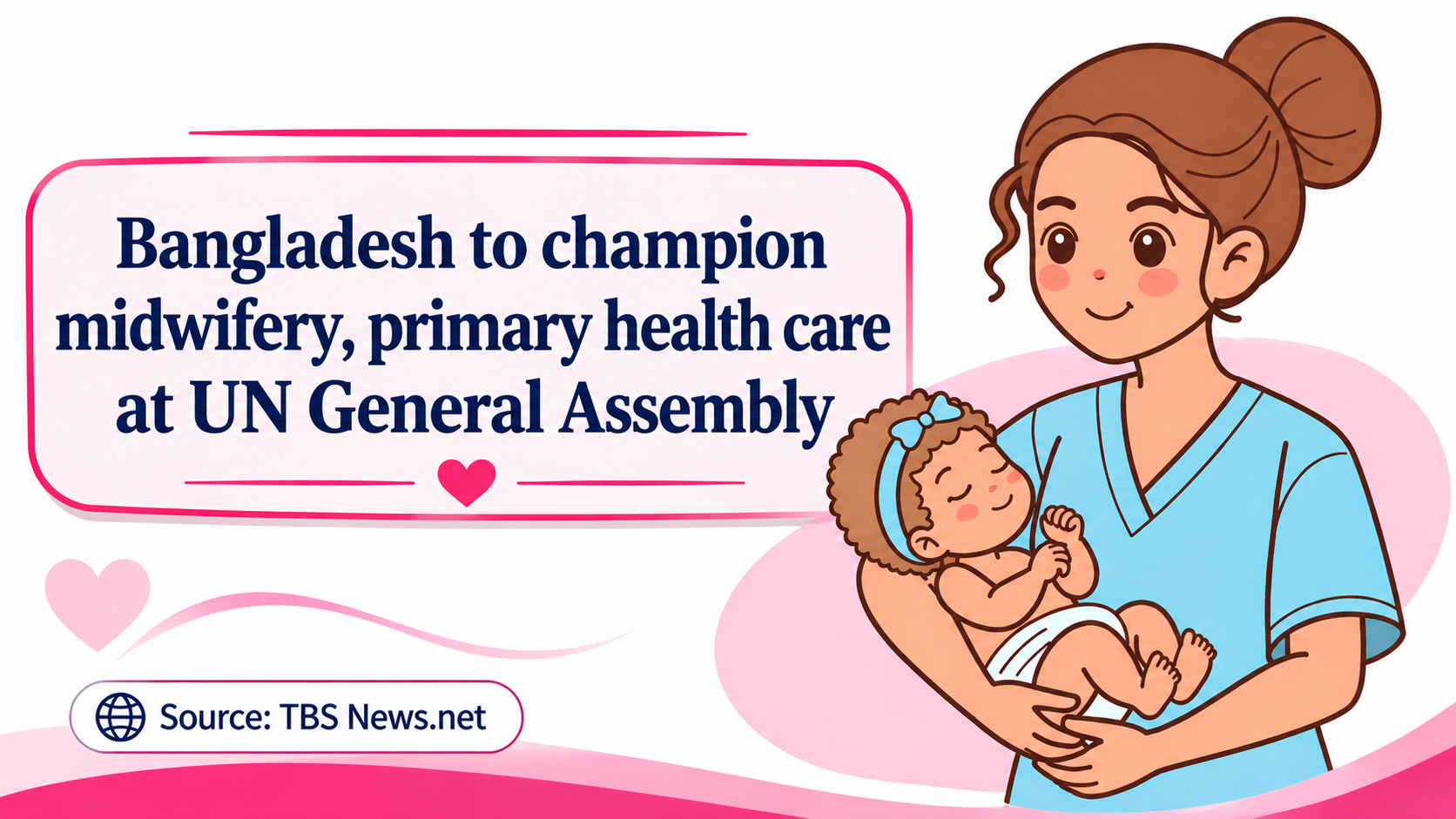
Bangladesh is strengthening its role in global maternal and newborn healthcare through a major commitment to professional midwifery. The country has highlighted the importance of skilled midwives in improving primary healthcare, supporting safe childbirth and preventing avoidable maternal and newborn deaths.
On 24 September 2026, Bangladesh and Sweden jointly hosted a high-level event at the United Nations Headquarters in New York. The event took place during the 81st Session of the United Nations General Assembly (UNGA), in partnership with the United Nations Population Fund (UNFPA).
Professional Midwifery in Bangladesh Gains Global Recognition
The event, titled “From Commitment to Action: Integrating Midwifery into Primary Health Care to End Preventable Maternal and Newborn Deaths,” brought international attention to the role of professional midwives.
Prime Minister Tarique Rahman addressed the gathering and presented Bangladesh’s vision of building a healthier and more equitable society. He highlighted the government’s “Healthy Bangladesh” initiative, which places primary healthcare at the centre of national health reform.
Meanwhile, Bangladesh and Sweden reaffirmed their commitment to strengthening professional midwifery. Their partnership also highlighted the importance of international cooperation in improving maternal and newborn healthcare.
Primary Healthcare and the Role of Skilled Midwives
Primary Health Care (PHC) provides essential health services within communities. It focuses on prevention, early diagnosis, maternal care and accessible medical support.
Professional midwives play an important role in this system. They support women throughout pregnancy, childbirth and the postnatal period. Furthermore, they identify health risks early and help mothers access appropriate medical care.
How Midwives Protect Mothers and Newborns
Skilled midwives promote safe and respectful childbirth. They also support breastfeeding, newborn care and healthy childhood development.
Consequently, stronger midwifery services can improve healthcare access, especially in rural and underserved communities. This approach also supports Universal Health Coverage (UHC), which aims to make essential healthcare accessible to everyone.
Bangladesh’s 25,000 Professional Midwifery Recruitment Plan
One of the most significant announcements involved the recruitment of 25,000 professional midwives across Bangladesh.
During the UN event, Prime Minister Tarique Rahman confirmed the government’s decision and stated that the recruitment process had begun.
Additionally, he outlined plans to recruit 100,000 additional health workers, with 80 percent expected to be women. These workers will connect families with healthcare services, identify health risks and support timely treatment.
However, workforce expansion requires more than recruitment. Bangladesh must also strengthen professional education, training, supervision and working conditions. These measures will help midwives deliver reliable services across different communities.
International Cooperation for Better Maternal Healthcare
The UNGA event brought together international health leaders and representatives from different regions. Participants discussed ways to strengthen primary healthcare through professional midwifery.
Ministers and representatives from countries including Mexico, Nepal, Sierra Leone, the Philippines, Indonesia and Thailand were expected to contribute to the discussions.
Furthermore, the event highlighted sustainable investment, workforce development and professional leadership. These priorities can help countries improve maternal healthcare while building stronger health systems.
A Global Vision for Safer Childbirth
Bangladesh’s commitment reflects a broader international effort to reduce preventable maternal and newborn deaths. It also highlights the importance of bringing essential healthcare closer to the people who need it most.
Ultimately, professional midwifery in Bangladesh represents an important step towards stronger community healthcare and safer childbirth. Through skilled professionals, international cooperation and long-term investment, Bangladesh aims to contribute to a healthier and more equitable future for mothers, newborns and families worldwide.

Primary Health Care
Primary Healthcare Integration in Bangladesh: Connecting Community Clinics, Union Health & Family Welfare Centres and Primary Healthcare Units
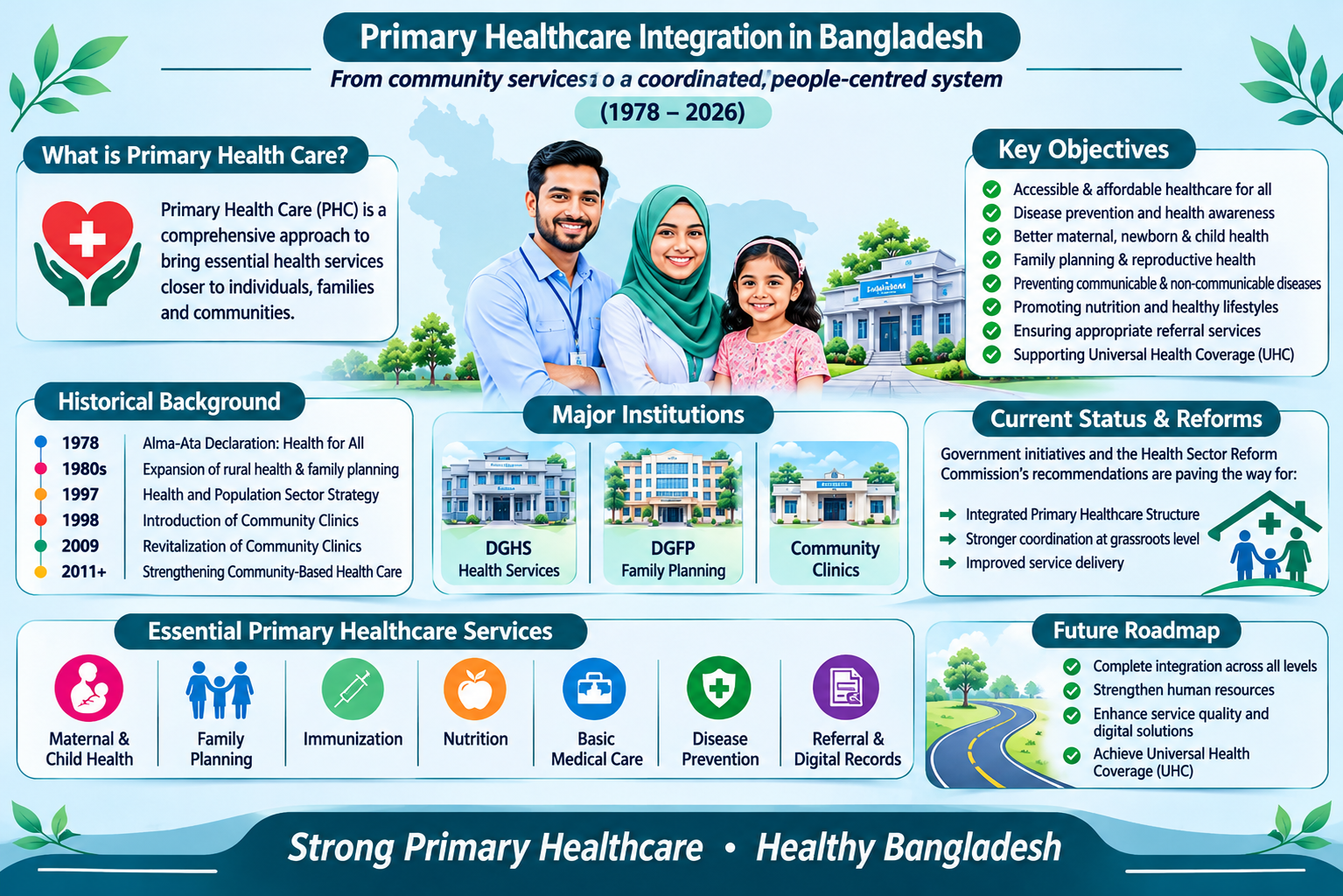
Primary Healthcare Integration in Bangladesh is an important step towards building a stronger, more accessible, and coordinated healthcare system. By connecting Community Clinics, Union Health and Family Welfare Centres (UH&FWCs), and proposed Primary Healthcare Units, Bangladesh aims to improve the delivery of essential healthcare services at the community level.
Primary Healthcare Integration in Bangladesh aims to improve access to essential healthcare services across communities.
Introduction to Primary Healthcare Integration in Bangladesh
Primary Health Care (PHC) is the foundation of an effective, equitable and sustainable healthcare system. It brings essential health services closer to individuals, families and communities. Moreover, it helps people receive necessary medical care without facing unnecessary financial difficulties.
In Bangladesh, primary healthcare services are delivered through several government institutions. These include the Directorate General of Health Services (DGHS), the Directorate General of Family Planning (DGFP) and the Community Clinic system. Each institution plays an important role in providing essential healthcare services.
However, differences in administrative structures, workforce management and service delivery have created several coordination challenges. Therefore, stronger collaboration between these institutions is necessary to improve healthcare services at the grassroots level.
Against this background, Primary Healthcare Integration in Bangladesh has become an important area of healthcare reform. The proposed reforms aim to improve coordination, strengthen community-based services and ensure better access to essential healthcare for everyone.
1. Primary Healthcare Integration in Bangladesh: Meaning and Importance
Primary Health Care (PHC) is a comprehensive approach that brings essential healthcare services closer to individuals, families and communities. According to the World Health Organization (WHO), primary healthcare goes beyond basic medical treatment. Moreover, it includes health promotion, disease prevention, early diagnosis, treatment, rehabilitation and coordination with higher levels of healthcare.
In addition, primary healthcare helps people access essential medical services without facing unnecessary financial hardship. For example, community-based healthcare facilities can provide basic consultations, preventive services and health education. Therefore, primary healthcare plays an important role in building an accessible and equitable healthcare system.
The major objectives of primary healthcare include:
- Ensuring accessible and affordable healthcare for everyone.
- Promoting disease prevention and health awareness.
- Improving maternal, newborn and child health.
- Strengthening family planning and reproductive health services.
- Preventing communicable and non-communicable diseases.
- Promoting nutrition and healthy lifestyles.
- Ensuring appropriate referral services.
- Supporting Universal Health Coverage (UHC).
Furthermore, these objectives help address the healthcare needs of different population groups. As a result, primary healthcare can contribute to better health outcomes and stronger community participation.
Primary healthcare is therefore not simply a healthcare facility or an individual medical service. Rather, it is a comprehensive system that connects communities with the broader national healthcare structure.
2. Primary Healthcare Integration in Bangladesh: Importance and Objectives
2.1 Alma-Ata Declaration and Primary Healthcare Integration
An important milestone in the global development of primary healthcare was the International Conference on Primary Health Care held in Alma-Ata, Kazakhstan, from 6 to 12 September 1978.
The conference adopted the Alma-Ata Declaration, emphasizing the principle of Health for All.
The declaration recognized primary healthcare as a fundamental approach to achieving equitable access to essential health services.
It also highlighted community participation, prevention, appropriate technology and intersectoral collaboration.
2.2 Development of Primary Healthcare Integration in Bangladesh
Following independence in 1971, Bangladesh gradually developed its public healthcare infrastructure to extend essential health services to rural and underserved populations.
Since then, health and family planning services have become important components of national development programmes. Over the years, several initiatives have contributed to the development of community-based primary healthcare in the country.
The following milestones highlight the major developments in Bangladesh’s primary healthcare system:
1971–1977: Post-independence Primary healthcare development
After independence, Bangladesh began strengthening its public health infrastructure. During this period, the government also expanded essential healthcare and family planning services.
1978: Global recognition of Primary Health Care
At the international level, the Alma-Ata Declaration established an important framework for community-oriented primary healthcare.
1980s: Expansion of rural health and family planning services
During the 1980s, government initiatives focused on improving access to healthcare. Additionally, greater attention was given to maternal health and family planning services at the grassroots level.
1990s: Strengthening community-based healthcare
Throughout this decade, efforts continued to expand rural healthcare facilities. At the same time, the integration of essential health and family planning services received greater attention.
1997: Health and Population Sector Strategy
To improve coordination and efficiency, the government developed a sector-wide approach to health and population services.
1998: Introduction of Community Clinics
Under the Health and Population Sector Programme (HPSP), Bangladesh introduced the Community Clinic initiative. Consequently, primary healthcare services began reaching rural communities more directly.
2001–2008: Disruption of Community Clinic activities
However, following a change in government, support for the initial Community Clinic programme was withdrawn. As a result, many related activities remained suspended during this period.
2009: Revitalization of Community Clinics
In response to the earlier disruption, the government initiated efforts to restore and strengthen community-based healthcare services.
2011 onwards: Strengthening Community-Based Health Care
From 2011 onwards, community-based healthcare became an increasingly important component of national health sector programmes. Furthermore, efforts continued to improve access to essential healthcare at the grassroots level.
2017–2022: Fourth Health, Population and Nutrition Sector Programme
During this period, community-based healthcare activities continued under the sector-wide health development framework.
2025: Health Sector Reform Commission
In 2025, the Health Sector Reform Commission submitted recommendations to improve primary healthcare, healthcare governance and workforce management.
2026: Renewed focus on Primary Healthcare Integration
More recently, government initiatives have placed greater emphasis on integrated healthcare delivery, workforce coordination, modern primary healthcare facilities and digital health systems.
3. Primary Healthcare Integration in Bangladesh: Existing Infrastructure and Services
Bangladesh’s public primary healthcare system operates through several levels of government healthcare facilities. At the grassroots level, Community Clinics and Union Health and Family Welfare Centres provide essential services to local communities. Meanwhile, Upazila Health Complexes offer additional medical support and referral services. Therefore, coordination among these facilities is important for an effective primary healthcare system.
3.1 Upazila Health Complex (UHC)
The Upazila Health Complex is an important government healthcare institution at the sub-district level. It provides a higher level of medical support to people living in rural areas. In addition, it serves as an important referral centre for patients who need further medical attention.
Its major services generally include:
- Outpatient consultations.
- Emergency medical services.
- Inpatient treatment.
- Maternal and child healthcare.
- Basic diagnostic services.
- Management of common illnesses.
- Referral services for patients requiring specialized treatment.
Furthermore, Upazila Health Complexes support patients referred from union-level and community-level healthcare facilities. As a result, they play an important role in connecting primary healthcare services with higher levels of medical care.
3.2 Union Health and Family Welfare Centre (UH&FWC)
Union Health and Family Welfare Centres are important rural healthcare facilities operating under the family planning service delivery structure. In particular, they help provide reproductive, maternal and family planning services to rural populations.
Their major services include:
- Family planning and contraceptive services.
- Antenatal Care (ANC).
- Postnatal Care (PNC).
- Maternal health counselling.
- Reproductive health services.
- Safe delivery-related services where facilities and trained personnel are available.
- Newborn and child health services.
- Adolescent health counselling.
- Nutrition education.
- Referral services when required.
Moreover, these centres help improve access to essential reproductive and maternal healthcare services. Therefore, stronger coordination with Community Clinics and Upazila Health Complexes can support more continuous and accessible healthcare delivery.
4. Primary Healthcare Integration and Healthcare Workforce
Bangladesh’s primary healthcare system depends on the contributions of different categories of frontline healthcare workers. These professionals work under separate administrative structures; however, they share the common goal of improving community health. Moreover, their combined efforts help deliver essential healthcare services to rural and underserved populations.
4.1 Health Assistant (HA)
Health Assistants work under the Directorate General of Health Services (DGHS). They play an important role in community-based public health activities. In particular, their responsibilities include:
- Participation in the Expanded Programme on Immunization (EPI).
- Prevention and surveillance of communicable diseases.
- Collection of public health information.
- Health education and community awareness.
- Support for maternal and child health activities.
- Participation in community-level healthcare programmes.
- Other assigned public health responsibilities.
Furthermore, their work supports disease prevention and health promotion at the grassroots level.
4.2 Family Welfare Assistant (FWA)
Family Welfare Assistants work under the Directorate General of Family Planning (DGFP). They are especially important in delivering household-level family planning and reproductive health services.
Their responsibilities include:
- Household visits.
- Family planning counselling.
- Distribution of contraceptive supplies.
- Reproductive health awareness.
- Counselling for eligible couples.
- Maternal and child health-related advice.
- Follow-up of family planning clients.
In addition, their household visits help identify the reproductive health needs of local families. Consequently, they contribute significantly to community-based family planning programmes.
4.3 Community Health Care Provider (CHCP)
Community Health Care Providers are associated with the Community Clinic Health Assistance Trust. They play a central role in delivering essential healthcare services through Community Clinics.
Their responsibilities generally include:
- Basic healthcare services.
- Initial assessment of common illnesses.
- Health education.
- Maternal and child health support.
- Nutrition counselling.
- Maintaining health records.
- Referral of patients when necessary.
Similarly, CHCPs help connect local communities with the broader public healthcare system. As a result, they contribute to improving access to essential healthcare services.
4.4 Importance of Workforce Coordination in Primary Healthcare Integration
Although these workforce groups operate under different administrative structures, their responsibilities often overlap in terms of public health objectives. For example, a single household may require immunization, family planning, maternal healthcare, nutrition counselling and general health advice.
Without proper coordination, unnecessary service duplication, fragmented information and gaps in healthcare delivery may occur. Therefore, an integrated approach can improve communication and clarify the responsibilities of different healthcare professionals.
Furthermore, coordinated supervision can strengthen accountability and ensure that essential healthcare services reach more households. However, integration should not eliminate professional distinctions or disregard the expertise of existing healthcare workers.
Ultimately, effective workforce coordination is essential for building a stronger, more accessible and integrated primary healthcare system in Bangladesh.
5. Health Sector Reform Commission Recommendations for Primary Healthcare Integration in Bangladesh
On 5 May 2025, the Health Sector Reform Commission submitted its recommendations to the government. These proposals focused on improving healthcare accessibility, affordability, governance and service quality. Furthermore, the commission emphasized the importance of strengthening primary healthcare as the foundation of the national healthcare system.
In particular, several recommendations addressed the need for better community-level healthcare services. The major recommendations related to primary healthcare included:
- Strengthening primary healthcare as a fundamental component of the national healthcare system.
- Considering legislation to establish a stronger legal framework for primary healthcare.
- Expanding access to free essential primary healthcare services.
- Improving community-level healthcare facilities.
- Strengthening union-level healthcare infrastructure.
- Improving the capacity of Upazila Health Complexes.
- Reviewing the responsibilities of frontline healthcare workers.
- Improving coordination between health and family planning services.
- Strengthening maternal, newborn and child healthcare.
- Expanding nutrition and adolescent health services.
- Improving the availability of essential medicines.
- Strengthening preventive and community-based healthcare.
Moreover, these recommendations highlighted the importance of coordinated healthcare delivery. Additionally, better workforce management and improved institutional cooperation could help address existing service delivery challenges.
However, these recommendations represent proposed reforms rather than confirmed government decisions. Therefore, they should not be interpreted as evidence that every recommendation has already been approved or implemented.
Overall, the commission’s recommendations provide an important policy direction for strengthening primary healthcare in Bangladesh.
6. Government Gazette of 17 March 2026 and Primary Healthcare Integration
A significant administrative development took place on 17 March 2026. On this date, an Extraordinary Gazette published by the Bangladesh Government Press contained a notification from the Prime Minister’s Office concerning the coordination and integration of frontline healthcare activities.
Furthermore, the notification highlighted the need for a more coordinated structure for field-level healthcare workers under the Directorate General of Health Services (DGHS) and the Directorate General of Family Planning (DGFP).
In particular, the initiative addressed several important areas:
- Future recruitment of one lakh healthcare workers.
- Training and capacity development.
- Integrated supervision of frontline healthcare activities.
- Improved coordination of primary healthcare delivery.
- Development of a more effective and people-oriented healthcare system.
Moreover, these initiatives indicate a stronger focus on coordination between existing healthcare institutions. Consequently, they may help improve the delivery of essential healthcare services at the community level.
However, it is important to distinguish administrative initiatives from completed reforms. The formation of a committee and the development of an integrated framework do not necessarily mean that institutional integration or recruitment has been completed.
Therefore, the implementation status of these initiatives should be assessed through subsequent government decisions and official notifications.
Overall, the Gazette represents an important administrative step towards strengthening Primary Healthcare Integration in Bangladesh.
7. Primary Healthcare Integration in the National Budget 2026–27
The National Budget for FY 2026–27 outlines several important plans to expand and modernize primary healthcare in Bangladesh. In particular, these initiatives aim to improve healthcare accessibility and strengthen community-level service delivery. Furthermore, the proposed measures focus on modern infrastructure, digital healthcare and workforce development.
7.1 One Primary Healthcare Unit in Every Union
The government has planned to establish one modern Primary Healthcare Unit in every union across Bangladesh. Through this initiative, people are expected to receive essential healthcare services closer to their homes. Moreover, these facilities are intended to provide affordable, accessible and prevention-focused healthcare.
7.2 Primary Healthcare Units in Urban Wards
In addition to rural healthcare development, the government has also outlined plans to establish one or more Primary Healthcare Units in every urban ward. As a result, urban populations are expected to have better access to essential healthcare services.
7.3 Three Community-Level Health Service Centres Under Each Unit
According to the budget speech, each Primary Healthcare Unit is planned to have three community-level health service centres, identified as Community Clinics. These centres are expected to provide preventive health counselling, maternal and child healthcare, nutrition support and essential primary healthcare services. Furthermore, trained community health workers are expected to play an important role in delivering these services.
7.4 Universal Health Card
Another important initiative is the proposed introduction of a modern Health Card for every citizen. Through this system, individuals are expected to access their health-related information more conveniently. For example, the proposed card may support the management of previous treatment records, investigations and medication history.
7.5 Integrated Patient Management System
Additionally, the proposed Integrated Patient Management System aims to improve patient information management. It is also expected to strengthen communication and coordination between different healthcare facilities. Consequently, healthcare providers may be able to manage patient information more effectively.
7.6 Integrated Patient Referral System
Similarly, the proposed Integrated Patient Referral System aims to make patient transfers between primary, secondary and specialized healthcare facilities more coordinated. Therefore, patients requiring additional medical attention may benefit from a more organized referral process.
7.7 Recruitment of Additional Healthcare Workers
The national healthcare development plan also includes the proposed recruitment of an additional one lakh healthcare workers. Moreover, additional personnel could help strengthen community-level healthcare delivery and support the expansion of primary healthcare services.
Overall, these initiatives indicate a broader policy direction towards expanding primary healthcare infrastructure and improving community-based service delivery. However, proposed plans should not be confused with completed implementation. Therefore, the progress of each initiative should be assessed separately through subsequent government decisions and official progress reports.
8. Proposed Directorate General of Primary Health Care (DGPHC)
The proposal for a dedicated primary healthcare administrative structure has become an important topic in Bangladesh’s healthcare reform process. In particular, the proposed Directorate General of Primary Health Care (DGPHC) aims to strengthen the institutional management and coordination of primary healthcare services.
Furthermore, discussions and administrative initiatives have focused on several important areas:
- Coordination of frontline healthcare workers.
- Integration of relevant health and family planning activities.
- Workforce planning and management.
- Development of organizational structures.
- Recruitment rules and service regulations.
- Training and professional development.
- Career planning and promotion opportunities.
- Strengthening supervision and accountability.
- Improving the delivery of essential healthcare services.
Proposed Health and Wellbeing Assistant Position
Another important topic in the ongoing administrative discussions concerns the proposed designation of relevant frontline personnel as Health and Wellbeing Assistants, also described in Bangla as সুস্বাস্থ্য কর্মী.
According to a government meeting notice dated 22 November 2026, the agenda reportedly included discussions about the proposed designation and related administrative arrangements.
In addition, the meeting agenda reportedly covered the following matters:
- Creation of the proposed positions.
- Development of recruitment rules.
- Formation of the proposed Directorate General of Primary Health Care.
- Introduction of model Su-Sasthya Centres in selected unions.
Moreover, these discussions indicate an interest in improving the organization and coordination of frontline healthcare services.
However, meeting agenda items and administrative proposals should not be treated as final government decisions. Similarly, the establishment of a new directorate, approval of new designations and implementation of recruitment rules are separate administrative processes.
Therefore, the final status of these proposals should be confirmed through relevant government approvals and official notifications.
9. Proposed Model for Primary Healthcare Integration in Bangladesh
An effective Primary Healthcare Integration model should connect national healthcare planning with community, union and upazila-level service delivery. Furthermore, each administrative level should have clearly defined responsibilities to ensure better coordination and accountability.
The following conceptual model explains how different levels of the healthcare system could work together.
National Level: Proposed Directorate General of Primary Health Care
At the national level, the proposed Directorate General of Primary Health Care could coordinate overall primary healthcare planning and management.
Its potential responsibilities include:
- National policy development.
- Primary healthcare planning.
- Workforce management.
- Budget allocation and monitoring.
- Training and professional development.
- Quality assurance.
- Digital health management.
Moreover, national-level coordination could help establish consistent healthcare standards across the country.
District Level: Administrative Coordination
At the district level, healthcare authorities could support the coordination and monitoring of primary healthcare activities.
Potential responsibilities include:
- District-level coordination.
- Workforce supervision.
- Administrative monitoring.
- Training support.
- Quality assessment.
In addition, district-level monitoring could help identify service delivery problems and improve accountability.
Upazila Level: Healthcare Supervision and Referral
Upazila-level administration could play an important role in connecting union-level healthcare facilities with higher-level medical services.
Its potential responsibilities include:
- Coordination of union-level services.
- Supervision of frontline healthcare workers.
- Referral management.
- Monitoring of service delivery.
- Support for community healthcare facilities.
Consequently, stronger coordination at this level could improve patient referrals and healthcare accessibility.
Union Level: Proposed Integrated Primary Healthcare Unit
At the union level, a proposed Integrated Primary Healthcare Unit could provide a range of essential healthcare services.
These services may include:
- Basic medical care.
- Family planning.
- Maternal and newborn healthcare.
- Child health.
- Adolescent health.
- Nutrition.
- Preventive healthcare.
- Non-communicable disease screening.
- Health education.
- Referral coordination.
Furthermore, these services could help address the healthcare needs of local communities more effectively.
Community Level: Community Clinics and Local Service Points
At the community level, Community Clinics and other community-based service points could bring essential healthcare services closer to households.
For example, these facilities could support preventive healthcare, maternal and child health, nutrition counselling and health education.
Moreover, effective communication between community health workers and union-level facilities could improve patient follow-up. As a result, people could receive more coordinated healthcare services.
Overall, this proposed arrangement aims to establish stronger connections between national administration, district coordination, upazila supervision, union-level facilities and community-based healthcare services.
Important Note: This is a conceptual model for discussion and does not represent an officially approved government organizational chart.
10. Proposed Essential Service Package for Integrated Primary Healthcare
An effective primary healthcare system should provide a comprehensive range of essential health services. In particular, these services should address the healthcare needs of individuals, families and communities. Moreover, service delivery should depend on available facilities, trained personnel and approved government responsibilities.
10.1 Primary Medical Care
Primary medical care provides initial assessment and basic treatment for common illnesses. Furthermore, early diagnosis can help identify health problems before they become more serious. Therefore, patients should receive appropriate advice and referrals whenever necessary.
10.2 Family Planning and Reproductive Health
Family planning is an essential component of integrated primary healthcare. In addition to contraceptive services, it includes reproductive health education, family planning counselling and couple counselling. Moreover, these services can help individuals and families make informed decisions about reproductive health.
10.3 Maternal Healthcare
Maternal healthcare supports women throughout pregnancy and after childbirth. For example, essential services include Antenatal Care (ANC), maternal health counselling and Postnatal Care (PNC). Additionally, safe delivery-related services should be provided where suitable facilities and trained personnel are available.
10.4 Newborn and Child Health
Newborn and child healthcare focuses on the health, growth and development of children. Furthermore, essential newborn care, growth assessment and child health monitoring can help identify potential health concerns. Consequently, families can receive appropriate health advice and referrals when required.
10.5 Adolescent Health
Adolescent healthcare addresses the physical, mental and reproductive health needs of young people. In particular, services may include adolescent health education, nutrition awareness and mental health promotion. Moreover, Sexual and Reproductive Health (SRH) counselling can support informed and responsible health decisions.
10.6 Nutrition Services
Nutrition services help improve the health of pregnant women, breastfeeding mothers, children and adolescents. For instance, healthcare workers can provide dietary advice, breastfeeding guidance and nutrition counselling. Additionally, regular growth monitoring can help identify nutritional problems at an early stage.
10.7 Immunization
Immunization protects individuals and communities against preventable infectious diseases. Through the national immunization programme, healthcare workers can support vaccination awareness, service delivery and follow-up activities. Therefore, coordinated immunization services are important for protecting public health.
10.8 Non-Communicable Disease Prevention
Non-communicable diseases, including diabetes and hypertension, require greater attention at the primary healthcare level. Accordingly, healthcare facilities can provide basic screening, health education and preventive counselling. Furthermore, patients who need additional medical attention should receive appropriate referrals.
10.9 Mental Health
Mental health is another important component of comprehensive primary healthcare. In addition to mental health awareness, basic counselling and early identification of common concerns can support individuals and families. However, patients requiring specialized treatment should be referred to appropriate healthcare professionals.
10.10 Community Health Education
Community health education helps people understand how to prevent diseases and maintain healthy lifestyles. For example, courtyard meetings, satellite clinics, school health education and awareness programmes can improve public knowledge. Moreover, active community participation can make these activities more effective.
10.11 Disease Prevention and Surveillance
Disease prevention and surveillance are essential for identifying and responding to public health threats. In particular, healthcare workers can support communicable disease prevention, community-level monitoring and health information collection. As a result, relevant authorities can identify potential health risks and take appropriate action.
10.12 Digital Health Services
Digital health services can improve the management and coordination of primary healthcare activities. For instance, digital health records, Health Cards and patient follow-up systems can support continuity of care. Furthermore, integrated referral management can improve communication between different healthcare facilities.
Overall, these essential services can help establish a more coordinated, accessible and people-centred primary healthcare system in Bangladesh. Therefore, effective planning, trained healthcare workers and proper institutional coordination are necessary for successful service delivery.
11. Healthcare Workforce Management and Professional Recognition
Human resource management is one of the most important components of successful Primary Healthcare Integration in Bangladesh. The country already has a large and experienced frontline healthcare workforce working under different administrative structures. Moreover, their professional experience and community-level knowledge represent an important national resource.
Therefore, any future integration process should carefully consider the following issues:
- Protection of existing employment rights.
- Recognition of educational qualifications.
- Assessment of professional experience and competencies.
- Clear job descriptions and responsibilities.
- Appropriate designation and professional recognition.
- Updated recruitment rules.
- Transparent promotion opportunities.
- Career development and professional training.
- Fair administrative arrangements.
- Appropriate recognition of existing institutional expertise.
The Importance of Family Planning Professionals in Primary Healthcare Integration
Family planning professionals have made significant contributions to Bangladesh’s reproductive health and maternal healthcare programmes. However, their responsibilities extend far beyond the distribution of contraceptive supplies.
In particular, their professional activities include:
- Family planning counselling.
- Reproductive health education.
- Maternal health awareness.
- Antenatal and postnatal health-related counselling.
- Couple counselling.
- Adolescent reproductive health awareness.
- Community-based health education.
- Household visits and follow-up.
- Participation in satellite clinics and community health programmes.
Furthermore, these professionals have valuable experience in delivering essential healthcare services at the household level. As a result, their knowledge can support stronger community-based primary healthcare programmes.
Additionally, their professional expertise should receive appropriate recognition in any future integrated healthcare structure.
Most importantly, integration should strengthen family planning and reproductive health services rather than weaken their importance or institutional identity.
Ultimately, successful workforce integration requires professional recognition, clear responsibilities, fair administrative arrangements and opportunities for career development.
12. Benefits of Primary Healthcare Integration in Bangladesh
Primary Healthcare Integration can bring several important benefits to Bangladesh. In particular, a coordinated healthcare system can improve service delivery, strengthen preventive healthcare and make essential medical services more accessible.
The potential benefits include:
1. Improved Accessibility
Integrated healthcare facilities can bring essential medical services closer to people’s homes. As a result, rural and underserved communities may receive better access to healthcare.
2. Better Coordination
Furthermore, improved coordination between health, family planning and community-based healthcare activities can strengthen service delivery. Consequently, patients may receive more continuous and organized healthcare support.
3. Reduced Duplication
With better workforce planning, healthcare institutions can reduce unnecessary repetition of household visits, information collection and similar service activities. In addition, clear responsibilities can help improve the use of available resources.
4. Stronger Preventive Healthcare
An integrated approach can place greater emphasis on disease prevention, early diagnosis and health education. Therefore, communities may become more aware of common health risks and preventive measures.
5. Improved Maternal and Child Health
Moreover, better coordination can strengthen maternal, newborn and child healthcare services. This includes improved access to maternal health counselling, newborn care and child health monitoring.
6. Stronger Family Planning Services
Family planning and reproductive health are essential components of primary healthcare. Through better coordination, these services can become more effectively connected with broader community healthcare programmes.
7. Improved Digital Healthcare
Digital Health Cards and integrated patient records can support better information management. For example, healthcare providers may access relevant patient information more efficiently. As a result, continuity of care can improve.
8. Better Referral Services
Similarly, stronger coordination between Community Clinics, union-level facilities and Upazila Health Complexes can improve patient referral services. Consequently, patients may receive appropriate medical attention at the right level of care.
9. Greater Efficiency
Effective workforce management and resource allocation can improve the overall efficiency of healthcare delivery. Furthermore, coordinated supervision can strengthen accountability across different levels of the healthcare system.
10. Progress Towards Universal Health Coverage
Ultimately, an integrated approach can help Bangladesh move closer to Universal Health Coverage (UHC). In this way, more people may gain access to equitable, affordable and quality healthcare services.
13. Major Challenges of Primary Healthcare Integration in Bangladesh
Despite its potential benefits, implementing an integrated primary healthcare system involves several administrative, technical and financial challenges. Therefore, successful integration requires careful planning, effective leadership and cooperation among relevant institutions.
The major challenges include:
- Coordination among existing government institutions.
- Development of a clear organizational structure.
- Revision of workforce responsibilities.
- Preparation of appropriate recruitment rules.
- Protection of existing employment rights.
- Ensuring professional recognition and career development.
- Recruitment of adequate medical and technical personnel.
- Improvement of rural healthcare infrastructure.
- Ensuring uninterrupted medicine supplies.
- Adequate budget allocation.
- Development of digital health infrastructure.
- Protection of patient information.
- Effective monitoring and accountability.
- Maintaining the quality of family planning and reproductive health services.
Furthermore, differences in institutional responsibilities may create difficulties during the transition towards an integrated system. At the same time, healthcare workers need clear job descriptions, appropriate training and fair administrative arrangements.
In addition, adequate financial resources and modern infrastructure are necessary to maintain service quality. However, technological improvements alone cannot solve every operational challenge.
Therefore, the Ministry of Health and Family Welfare, relevant directorates, healthcare professionals, policymakers and development partners must work together to address these issues.
14. Roadmap for Implementing Primary Healthcare Integration in Bangladesh
Successful Primary Healthcare Integration requires a well-planned and gradual implementation process. Accordingly, a phased approach can help Bangladesh establish an effective, coordinated and sustainable primary healthcare system.
Phase 1: Policy and Administrative Framework
First, the government needs to establish a clear policy and administrative structure.
Key activities include:
- Finalize the institutional structure.
- Review existing workforce responsibilities.
- Develop appropriate recruitment rules.
- Establish clear professional and administrative arrangements.
- Define accountability mechanisms.
Phase 2: Infrastructure and Workforce Development
Next, attention should focus on healthcare infrastructure and human resource development.
Important activities include:
- Improve union-level healthcare facilities.
- Recruit adequate medical and technical personnel.
- Provide professional training.
- Ensure the availability of essential medicines and equipment.
Phase 3: Pilot Implementation
After establishing the necessary administrative arrangements, selected unions could introduce pilot integrated healthcare facilities.
During this phase, the government could:
- Introduce model integrated healthcare facilities in selected unions.
- Establish coordinated workforce responsibilities.
- Evaluate service quality.
- Collect community feedback.
- Identify operational challenges.
As a result, policymakers could identify practical problems before considering nationwide expansion.
Phase 4: Digital Health Transformation
Meanwhile, digital healthcare systems could improve information management and coordination.
The proposed activities include:
- Introduce digital Health Cards.
- Develop Electronic Patient Records.
- Implement Integrated Patient Referral Systems.
- Strengthen digital monitoring and reporting.
Furthermore, these systems could support better patient follow-up and communication between healthcare facilities.
Phase 5: Nationwide Expansion
Finally, successful pilot programmes could be expanded gradually across the country.
The main activities would include:
- Evaluate pilot programmes.
- Expand successful models gradually.
- Ensure adequate financial and human resources.
- Strengthen supervision and accountability.
Overall, this roadmap represents a proposed implementation framework. However, it should not be interpreted as an officially approved government timeline.
15. Future of Primary Healthcare Integration in Bangladesh
Bangladesh has an important opportunity to develop a modern, coordinated and people-centred primary healthcare system. However, long-term success will depend on effective governance, adequate resources and a skilled frontline healthcare workforce.
The following priorities could guide future healthcare reforms.
One Union, One Integrated Primary Healthcare System
Every union should have an effective primary healthcare management system. In addition, healthcare facilities should work together to provide coordinated essential services to local communities.
One Household, Coordinated Health Services
Every household should have access to coordinated healthcare services. Consequently, better communication between healthcare workers could reduce unnecessary duplication and service gaps.
One Citizen, One Health Record
A modern digital health record system could help maintain relevant health information for every citizen. Furthermore, integrated digital records may improve patient follow-up and continuity of care.
Prevention First
Preventive healthcare should remain a major priority. For example, disease awareness, nutrition education, early diagnosis and healthy lifestyle promotion can help reduce future health risks.
Strong Family Planning Services
Family planning, reproductive health, maternal healthcare and adolescent health services should remain essential components of the integrated system. Moreover, the experience of existing family planning professionals should receive appropriate recognition.
Skilled and Dignified Healthcare Workforce
Healthcare workers need appropriate professional recognition, clear responsibilities and opportunities for career development. In addition, regular training and fair administrative arrangements can strengthen workforce performance.
Quality Healthcare for All
Finally, every citizen should have access to affordable, accessible, safe and quality healthcare services. Therefore, future reforms should remain focused on equity, accountability and the actual healthcare needs of communities.
16. Conclusion: Strengthening Primary Healthcare Integration in Bangladesh
Bangladesh has a long history of developing community-based primary healthcare services. Community Clinics, Union Health and Family Welfare Centres and Upazila Health Complexes have played important roles in expanding access to essential healthcare.
Furthermore, frontline healthcare workers under the Directorate General of Health Services, Directorate General of Family Planning and the Community Clinic system have made significant contributions to community health.
However, changing population needs, emerging health challenges, non-communicable diseases and technological advancements require a stronger and more coordinated healthcare system.
In this context, the Health Sector Reform Commission’s recommendations in 2025, the government gazette of 17 March 2026 and the Primary Healthcare Unit initiatives outlined in the FY 2026–27 National Budget represent important developments in Bangladesh’s healthcare reform process.
Additionally, administrative discussions surrounding a proposed Directorate General of Primary Health Care have brought further attention to the future management of primary healthcare services.
Nevertheless, successful integration requires much more than establishing a new directorate or constructing healthcare facilities. It also requires competent healthcare professionals, clear institutional responsibilities, adequate funding, essential medicines, professional training and effective governance.
In particular, the experience and achievements of Bangladesh’s family planning workforce must receive appropriate recognition. At the same time, future reforms should strengthen reproductive health, maternal healthcare and family planning services.
Ultimately, the success of Primary Healthcare Integration in Bangladesh will depend on cooperation among government institutions, healthcare professionals and local communities.
The main objective should be to establish a modern, equitable, accessible and sustainable primary healthcare system that brings essential healthcare services closer to every citizen.
Strong Primary Healthcare, Healthy Bangladesh — A stronger primary healthcare foundation is essential for building a healthier, more equitable and prosperous nation.
Frequently Asked Questions (FAQs)
1. What is Primary Healthcare Integration?
Primary Healthcare Integration is an approach that coordinates different healthcare services, institutions and frontline workers to deliver comprehensive and accessible healthcare to individuals and communities.
2. Why is Primary Healthcare Integration important in Bangladesh?
It can improve coordination between health and family planning services, reduce unnecessary duplication, strengthen preventive healthcare and improve access to essential services.
3. Which institutions are important in Bangladesh’s primary healthcare system?
The Directorate General of Health Services (DGHS), Directorate General of Family Planning (DGFP), Community Clinic system and Upazila Health Complexes are important components of the public healthcare system.
4. What is the proposed Directorate General of Primary Health Care?
The proposed Directorate General of Primary Health Care (DGPHC) is an institutional reform initiative intended to strengthen the coordination and management of primary healthcare services.
Its final establishment and organizational arrangements require formal government approval.
5. What is a Health and Wellbeing Assistant?
Health and Wellbeing Assistant, or Su-Sasthya Kormi, is a proposed designation discussed in a government meeting agenda in November 2026. Its final approval and recruitment rules should be confirmed through official government notifications.
6. What is a Primary Healthcare Unit?
A Primary Healthcare Unit is a proposed modern union-level healthcare facility intended to provide accessible, affordable and prevention-focused essential healthcare services.
7. How many Community Clinics are planned under each Primary Healthcare Unit?
According to the FY 2026–27 National Budget speech, three community-level health service centres are planned under each Primary Healthcare Unit.
8. What is the role of family planning in integrated primary healthcare?
Family planning is an essential component of primary healthcare. It supports reproductive health, maternal health, contraceptive services, couple counselling and adolescent reproductive health education.
9. What is a Universal Health Card?
A Universal Health Card is a proposed digital health identification system intended to support access to citizens’ health records and improve continuity of healthcare services.
10. What is the future of primary healthcare Integration in Bangladesh?
The future direction includes stronger community-based healthcare, integrated workforce management, modern Primary Healthcare Units, digital health records, improved referral systems and greater emphasis on preventive healthcare.
References and Official Resources
The following resources provide background information and official documentation relating to primary healthcare in Bangladesh.
- World Health Organization (WHO)
Alma-Ata Declaration and Primary Health Care.
https://www.who.int/teams/social-determinants-of-health/declaration-of-alma-ata - World Health Organization Bangladesh
Strengthening Community-Based Health Services.
https://www.who.int/bangladesh/activities/strengthening-community-based-health-services/strengthening-community-based-health-services - Bangladesh Government Press
Extraordinary Gazette, 17 March 2026.
https://www.dpp.gov.bd/bgpress/index.php/document/get_extraordinary/61077 - Ministry of Finance, Government of Bangladesh
National Budget Speech 2026–27.
https://customs.gov.bd/files/BudgetSpeech_2026_2027_E.pdf - The Business Standard
Health Sector Reform Commission Recommends Free Primary Healthcare, 5 May 2025.
https://www.tbsnews.net/bangladesh/health/health-sector-reform-commission-recommends-primary-healthcare-separate-medical - The Daily Star
Family Planning Department and Proposed Primary Healthcare Reforms.
https://www.thedailystar.net/news/bangladesh/news/family-planning-dept-be-carved-out-primary-healthcare-4318786 - Directorate General of Health Services (DGHS)
https://dghs.gov.bd/ - Directorate General of Family Planning (DGFP)
https://dgfp.gov.bd/ - Community Clinic Health Assistance Trust
https://communityclinic.gov.bd/ - WHO Bangladesh – Community-Based Health Services Report
https://cdn.who.int/media/docs/default-source/searo/bangladesh/pdf-reports/cbhs-report-final-report-2019.pdf
Publication Information
Website: PrimaryHealthcareBD.com
Article Title: Primary Healthcare Integration in Bangladesh: History, Current Status, Government Initiatives, Reform Proposals and Future Roadmap
Category: Primary Health Care
Article Language: English
Information Updated: 27 November 2026
Editorial Disclaimer: This article is intended for educational and informational purposes. It distinguishes existing healthcare institutions and documented government initiatives from proposed administrative reforms and future plans. Proposals, meeting agendas and policy recommendations should not be interpreted as final government approvals unless confirmed through official notifications. The article should be updated when new government decisions or implementation reports become available.
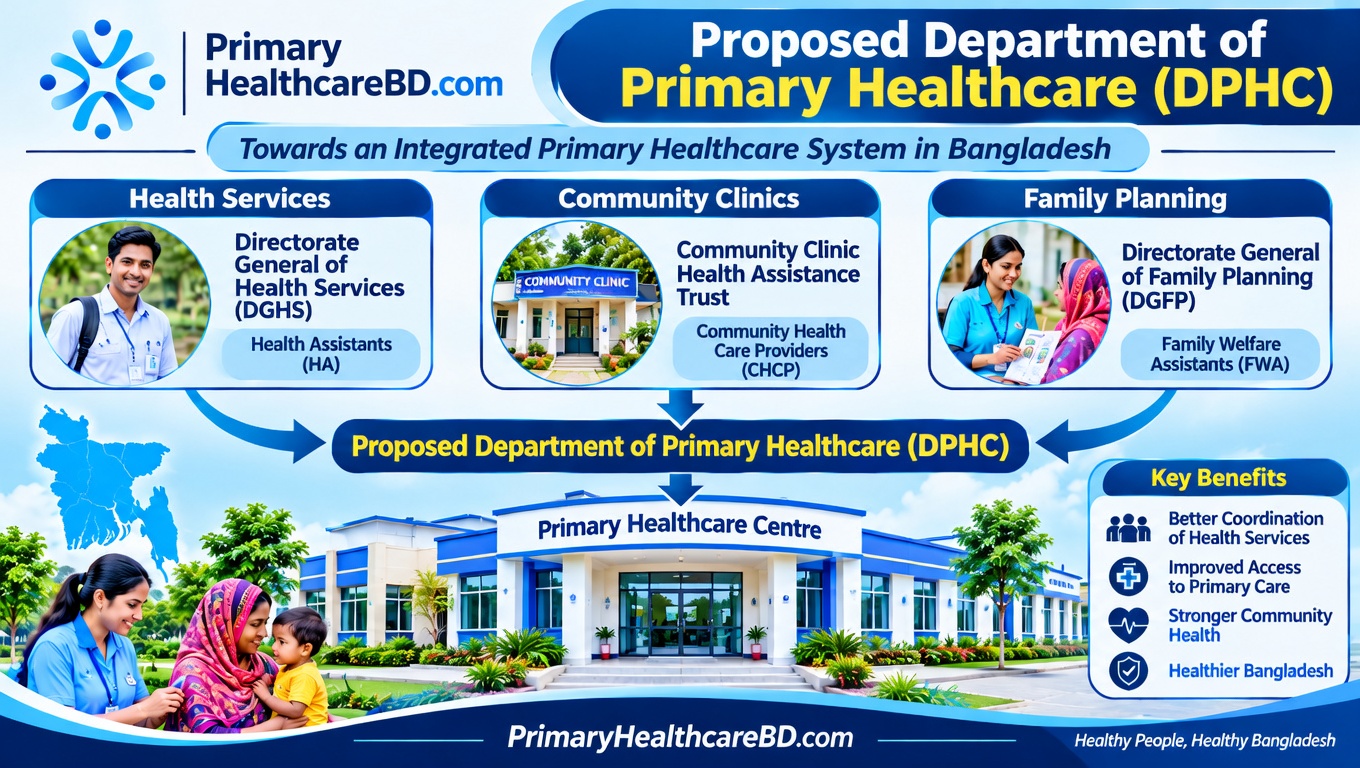
The Department of Primary Healthcare in Bangladesh (DPHC) is a proposed major healthcare reform initiative aimed at transforming the country’s primary healthcare system. Bangladesh is preparing for a major transformation through administrative reform, integrating grassroots health services, strengthening community-based healthcare and improving access to essential medical services across the country.
Bangladesh is preparing for a major transformation of its primary healthcare system. To achieve this goal, the government plans an administrative reform that will integrate grassroots health services, strengthen community-based healthcare and improve access to essential medical services across the country.
The proposed Department of Primary Healthcare (DPHC) will bring greater coordination among grassroots health services, strengthen community-based healthcare and improve access to essential medical services across the country. Additionally, the initiative focuses on integrating frontline healthcare workers, expanding recruitment and strengthening healthcare infrastructure at the union, ward and upazila levels.
Department of Primary Healthcare in Bangladesh: Executive Summary & Key Takeaways
- Administrative Reform: The government plans to establish the Department of Primary Healthcare in Bangladesh (DPHC) through the proposed reorganization of the Directorate General of Family Planning (DGFP).
- Unified Frontline Workforce: The proposed framework aims to integrate Health Assistants (HAs), Community Health Care Providers (CHCPs), Family Welfare Assistants (FWAs) and under a coordinated primary healthcare system.
- New Workforce Recruitment: Furthermore, the government has announced plans to recruit approximately 100,000 additional community health workers over the next three years.
- Integrated Healthcare Services: The proposed system aims to strengthen maternal health, child health, family planning, reproductive health, nutrition and preventive healthcare.
- Infrastructure Development: The Department of Primary Healthcare in Bangladesh aims to strengthen healthcare infrastructure by upgrading Upazila Health Complexes and establishing additional primary healthcare facilities at union and urban ward levels.
- Organisational Reform: A seven-member committee has been assigned to examine the proposed organogram, workforce structure, job responsibilities and career development arrangements.
1. Department of Primary Healthcare in Bangladesh: Latest Government Initiatives
Bangladesh’s healthcare administration is moving towards a significant structural transformation, with the government focusing on strengthening primary healthcare and improving community-level service delivery.
In addition, the Ministry of Health and Family Welfare (MOHFW) has initiated plans to bring different categories of frontline healthcare workers under a more coordinated administrative structure.
On November 26, 2026, Health Minister Sardar Md. Sakhawat Hossain Bakul and State Minister for Health Dr. M A Muhit highlighted the government’s healthcare priorities, including workforce recruitment, infrastructure development and improvements in grassroots healthcare services.
In particular, the broader policy direction focuses on preventive healthcare, early disease detection and accessible primary medical services.
As a result, the government aims to reduce pressure on major hospitals while ensuring that people in rural and underserved communities receive essential healthcare services closer to their homes.
2. Department of Primary Healthcare in Bangladesh: Proposed Structure and Reform
The proposed Department of Primary Healthcare in Bangladesh aims to create a unified administrative structure by improving coordination between existing healthcare institutions.
The proposal aims to establish a more integrated administrative framework for primary healthcare services by improving coordination between the Directorate General of Health Services (DGHS), the Directorate General of Family Planning (DGFP) and the Community Clinic Health Assistance Trust.
Historically, health services and family planning activities have operated through separate administrative structures. However, their responsibilities frequently overlap at the community level, and differences in management and operational arrangements have sometimes created duplication and coordination challenges.
Therefore, the proposed DPHC framework seeks to address these issues by bringing relevant services under a more coordinated system.
However, the final organisational structure, administrative authority and implementation arrangements will depend on official government decisions and notifications.
3. Department of Primary Healthcare: Workforce Integration in Bangladesh
The proposed primary healthcare reform will place frontline healthcare personnel at the centre of its integration strategy.
At the same time, the government intends to coordinate existing field-level healthcare workers from different institutions under a unified service delivery framework.
Proposed Frontline Healthcare Integration Model
| Existing Institution | Existing Workforce | Proposed Healthcare Responsibilities |
|---|---|---|
| Directorate General of Health Services (DGHS) | Health Assistants (HAs) | Immunisation, disease prevention and community health activities |
| Community Clinic Health Assistance Trust | Community Health Care Providers (CHCPs) | Community-level consultations and essential primary healthcare |
| Directorate General of Family Planning (DGFP) | Family Welfare Assistants (FWAs) | Family planning, reproductive health and maternal healthcare |
| Directorate General of Family Planning (DGFP) | Family Planning Inspectors (FPIs) | Field-level supervision, coordination and family planning programme management |
Under the proposed framework, frontline healthcare workers may operate through Health and Wellbeing Centres established at union and urban ward levels.
The proposed centres aim to improve access to essential healthcare services, including:
- Maternal and newborn healthcare.
- Family planning and reproductive health.
- Child health and nutrition counselling.
- Immunisation and disease prevention.
- Preventive healthcare and health education.
- Community-based healthcare and household visits.
In addition, the proposed service delivery model envisages regular household visits to improve healthcare coverage and ensure that families receive essential health information and services.
The final designation, job descriptions, reporting arrangements and responsibilities of the integrated workforce will depend on the approved administrative framework.
4. Department of Primary Healthcare in Bangladesh: Recruitment Plans
To strengthen community-level healthcare, the Department of Primary Healthcare in Bangladesh aims to improve workforce recruitment, coordination and healthcare facilities.
A. Recruitment of Approximately 100,000 Community Health Workers
The government plans to recruit approximately 100,000 additional community health workers over the next three years.
Furthermore, according to published reports, the proposed recruitment programme could increase the total frontline community healthcare workforce to approximately 150,000, including existing personnel.
The initiative aims to expand community-level preventive healthcare and improve access to essential health services, particularly in rural and underserved areas.
B. Recruitment of 10,000 Doctors
The government has also announced plans to strengthen the country’s medical workforce through additional doctor recruitment.
According to ministerial announcements, recruitment of 5,000 doctors is underway through a special BCS examination, with another 5,000 doctors planned for subsequent recruitment.
Consequently, these initiatives aim to address shortages of medical professionals and improve healthcare delivery across the country.
C. Expansion of Specialized Healthcare Facilities
The government has also highlighted plans to make previously constructed but non-operational specialized healthcare facilities functional by ensuring the necessary equipment, medical personnel and administrative arrangements.
These initiatives include specialized children’s healthcare facilities and regional trauma services.
5. Seven-Member Committee for the Proposed DPHC Organogram
The Health Services Division has formed a seven-member committee to examine the organisational and administrative framework of the proposed Department of Primary Healthcare.
Additional Secretary (Administration) Khorshed Alam leads the committee, which also includes representatives from relevant healthcare institutions.
Specifically, the committee has the following key responsibilities:
- Preparing the proposed DPHC organogram and administrative structure.
- Examining staffing arrangements and organisational hierarchy.
- Defining job descriptions and responsibilities.
- Reviewing workforce integration and transfer arrangements.
- Examining seniority protection and promotion opportunities.
- Developing recommendations for career progression and professional development.
- Identifying administrative challenges during the transition.
Protection of Existing Employees
The protection of existing employees is one of the most important considerations in the proposed restructuring.
At the same time, the transition process should ensure that the service rights, seniority, pay scales, financial benefits and career opportunities of existing employees receive proper consideration.
Clear administrative policies and transparent implementation guidelines will be essential to protect the professional interests of all existing frontline healthcare workers.
The final employee protection arrangements should be confirmed through official government decisions and relevant notifications.
6. Department of Primary Healthcare in Bangladesh: Infrastructure Development
Alongside administrative reform, the government also plans significant infrastructure development to strengthen healthcare facilities across the country
A. Upgrading All 503 Upazila Health Complexes
The government plans to upgrade all 503 Upazila Health Complexes into 151-bed facilities.
More importantly, the initiative aims to improve emergency services, maternal healthcare, diagnostic facilities and treatment capacity at the upazila level.
Strengthening these facilities could reduce pressure on tertiary hospitals and improve access to essential medical treatment closer to people’s homes.
B. Establishing Union and Ward-Level Primary Healthcare Facilities
Additionally, another major component involves expanding primary healthcare infrastructure across rural unions and urban wards.
The proposed facilities could provide accessible community-level services, including:
- Maternal and newborn healthcare.
- Family planning and reproductive health services.
- Child health and nutrition counselling.
- Immunisation and disease prevention.
- Basic health assessments.
- Preventive healthcare and health education.
These facilities are expected to play an important role in improving healthcare access for rural and urban communities.
C. Financial Investment
According to published reports, the government has proposed major infrastructure development projects with a combined estimated investment of approximately Tk 56,750.64 crore.
The proposed investments aim to expand hospital capacity, establish new primary healthcare facilities and improve existing healthcare infrastructure.
The implementation of these projects will depend on the approval of relevant development project proposals, budgetary allocations and subsequent government decisions.
7. Expert Perspectives and Implementation Challenges
Overall, the proposed integration of health and family planning services could improve coordination, reduce duplication and strengthen community-level healthcare delivery.
However, bringing different government institutions and professional groups under a unified administrative structure requires careful planning.
Furthermore, policymakers need to address several important issues:
- Protection of existing employees’ seniority and service benefits.
- Clear job descriptions and accountability mechanisms.
- Transparent recruitment and transfer policies.
- Appropriate promotion opportunities and career development.
- Continuity of family planning and reproductive healthcare services.
- Adequate training, equipment, medicines and logistical support.
- Effective coordination between primary, secondary and tertiary healthcare facilities.
The success of the proposed reform will ultimately depend on effective planning, stakeholder consultation, adequate resources and transparent implementation.
8. Frequently Asked Questions (FAQ)
1. What is the Department of Primary Healthcare (DPHC)?
The Department of Primary Healthcare (DPHC) is a proposed administrative entity intended to strengthen and coordinate primary healthcare services in Bangladesh through the planned reorganisation of existing healthcare structures.
2. Which healthcare workers may be integrated under the proposed framework?
The proposed integration framework includes Health Assistants, Community Health Care Providers, Family Welfare Assistants and Family Planning Inspectors.
3. Will existing Family Planning employees lose their jobs?
The proposed reform aims to reorganise and coordinate existing healthcare services. However, final decisions regarding employment, transfer, seniority and service protection will depend on official government policies.
4. How many new community health workers does the government plan to recruit?
The government has announced a plan to recruit approximately 100,000 additional community health workers over the next three years.
5. Will family planning services continue under the proposed system?
Family planning and reproductive healthcare are important components of the proposed integrated primary healthcare framework. Their future administrative arrangements will be determined through the restructuring process.
6. Has the Department of Primary Healthcare officially started operating?
The government has initiated the restructuring process and formed a committee to examine the proposed organisational structure. The final establishment and operational arrangements will require further official decisions and notifications.
Conclusion
Ultimately, the proposed establishment of the Department of Primary Healthcare could mark an important milestone in Bangladesh’s healthcare administration.
By strengthening coordination between health services and family planning programmes, integrating frontline healthcare activities and expanding community-level infrastructure, the initiative could improve access to essential healthcare services across the country.
However, successful implementation will require a clear administrative framework, protection of existing employees’ professional rights, adequate resources and effective coordination among all relevant institutions.
Ultimately, the coming months will be important in determining how the proposed reforms are translated into practical changes in Bangladesh’s primary healthcare system.
Editorial Note
This article has been prepared based on publicly reported government initiatives, ministerial statements and available information concerning the proposed restructuring of primary healthcare services in Bangladesh.
The proposed Department of Primary Healthcare, workforce integration arrangements and related administrative changes should not be interpreted as fully implemented until confirmed through official government notifications, approved organograms and relevant policy documents.
PrimaryHealthcareBD.com will continue to monitor official announcements and provide updates as further information becomes available.
Sources and Further Reading
- The Daily Star – Reports on the proposed restructuring of the Directorate General of Family Planning.
- The Daily Star – Government plans to recruit one lakh health workers over three years.
- Bangladesh Sangbad Sangstha (BSS) – Reports on primary healthcare infrastructure development.
- The Business Standard (TBS) – Reports on healthcare workforce and recruitment initiatives.
- Ministry of Health and Family Welfare – Official statements and relevant notifications.
-
 DPHC2 days ago
Department of Primary Healthcare in Bangladesh – Reform Proposal
-
 Family Planning Updates17 hours ago
Family Planning Campaign in Bangladesh: December 13 Launch
-
 Primary Health Care1 day ago
Primary Healthcare Integration in Bangladesh: Connecting Community Clinics, Union Health & Family Welfare Centres and Primary Healthcare Units
-
 Primary Health Care18 hours ago
Bangladesh Indonesia Healthcare Cooperation: A New Partnership